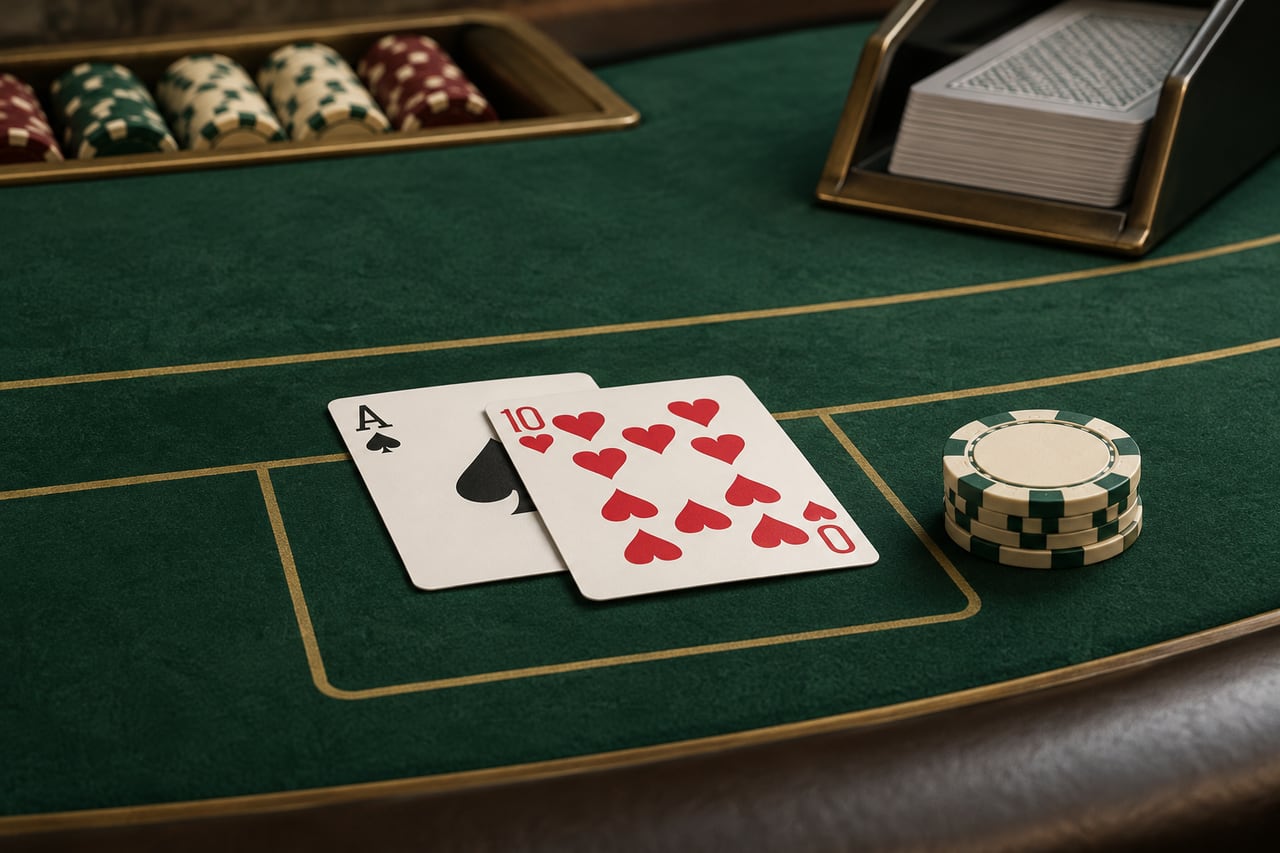
Aim to beat the dealer without going over 21
Number cards use their face value, picture cards count as ten, and an ace can count as one or eleven. A “soft” hand contains an ace counted as eleven; a “hard” hand does not. A total above 21 is a bust.
A natural blackjack is normally an ace plus a ten-value card in the initial two-card hand. A three-card 21 is not the same thing, and a 21 after splitting can have different treatment. Read the exact rules and payout before playing.
Know the available decisions
| Decision | What it usually does |
|---|---|
| Hit | Take another card |
| Stand | Keep the current total |
| Double | Add a permitted extra stake and take one final card |
| Split | Turn an eligible pair into separate hands with another stake |
| Surrender | End the hand for a specified partial loss, where allowed |
Availability and restrictions vary. Doubling and splitting increase money exposed in the round, so the first displayed stake may not be the final total.
See how a soft hand changes
An ace and a six can count as 7 or 17. If a ten arrives, the ace becomes one and the total is 17 rather than 27. That flexibility matters when reading a strategy chart: soft 17 and hard 17 are different hands.
The dealer follows the table’s prescribed drawing rules. Check whether the dealer hits or stands on soft 17 and whether the game uses a hole card. These details can affect decisions and settlement.
Check the blackjack payout
On a $10 natural blackjack, a 3:2 payout means $15 profit; 6:5 means $12 profit, assuming the hand wins under the applicable rules. Both return the stake as well. The familiar name “blackjack” does not mean two tables offer identical terms.
The Massachusetts rules are an example of detailed official rules, not confirmation of your online table’s configuration.
Keep a table-rules note
Before using any decision chart, record the rules it assumes alongside the table’s rules:
- Deck count and whether the dealer hits or stands on soft 17.
- Natural-blackjack payout, including any exceptions after a split.
- Which hands may double and whether doubling after a split is allowed.
- Split restrictions, surrender availability and hole-card rules.
An unknown item is a reason to consult the table help, not fill in the most familiar rule. This guide explains the actions and checks; it does not supply a strategy chart for every variant. Once you have the actual rules, choose learning material that matches them.
Use strategy with the right expectations
Basic strategy compares decisions under stated rules. A chart for different deck counts or table conditions may not fit. It can reduce avoidable decision errors, but it cannot guarantee a winning session.
Insurance and side bets have separate payouts and risks. You can decline them. Read common beginner mistakes before adding extra wagers, and keep the full possible round cost within your prior limit.